


Losing multiple teeth changes everything. Eating becomes difficult. Speaking clearly takes effort. Smiling feels self-conscious. And the longer those gaps stay empty, the more the jawbone shrinks and the face begins to change shape.
Dentures restore what’s been lost. Whether you’re missing a few teeth in one area or all of your teeth on the upper arch, the lower arch, or both, a well-made denture gives you back the ability to chew comfortably, speak naturally, and smile without hesitation.
Modern dentures look far more natural than they used to. The teeth are shaped and shaded to look realistic, and the base is tinted to match the color of your gums. Most people won’t be able to tell you’re wearing them.
At K&E Family Dental, we work with you to find the right type of denture for your situation, whether that’s a traditional removable option, a partial that fills in specific gaps, or an implant-supported denture that locks firmly into place.
Types of Dentures We Offer
Full Dentures
Full dentures replace an entire arch of teeth, upper, lower, or both. The denture base is custom-made from acrylic that matches your gum tissue, and the replacement teeth are positioned to restore your natural bite and facial structure.
Full dentures rest on the gums and are held in place by suction (for upper dentures) or by the shape of the jaw ridge (for lower dentures). Denture adhesive can be used for additional security. They’re removed at night for cleaning and to give your gums time to rest.
Full dentures are typically recommended when all or most of the teeth in an arch are missing or need to be extracted. If you still have a few remaining teeth, your dentist will evaluate whether those teeth can be saved or whether a full denture would give you a better long-term result.
Partial Dentures
Partial dentures replace one or more missing teeth when healthy natural teeth still remain on the same arch. The replacement teeth are attached to a gum-colored base, which is connected to a metal or flexible framework that clasps onto your existing teeth for support.
Partials fill in gaps, prevent your remaining teeth from shifting out of position, and restore your ability to chew evenly. They’re removable for cleaning and sleeping.
A partial denture is a good option when you’re missing several teeth but don’t need or aren’t ready for implants or bridges. It’s also a practical solution when the remaining teeth aren’t strong enough to support a fixed bridge.
Immediate Dentures
Immediate dentures are placed the same day your teeth are extracted, so you never have to go without teeth during the healing process. They’re made in advance based on impressions taken before your extractions.
The benefit is obvious: you walk out of the extraction appointment with teeth in place. The tradeoff is that your gums and bone will change shape as they heal over the following months, which means immediate dentures typically need to be relined or remade once healing is complete (usually after three to six months). Many patients choose immediate dentures as a transitional step while their permanent dentures are being fabricated.
Implant-Supported Dentures
For patients who want the stability and confidence of a fixed restoration without the drawbacks of traditional removable dentures, implant-supported dentures are a game-changer.
Two to six dental implants are placed in the jawbone, and the denture snaps or screws onto those implants. The result is a set of teeth that doesn’t slip, doesn’t require adhesive, and lets you eat virtually anything. Implant-supported dentures also preserve jawbone because the implants stimulate the bone the same way natural tooth roots do.
There are two main types. Overdentures (snap-on) clip onto implant attachments and can be removed for cleaning. Fixed implant dentures (sometimes called All-on-4 or All-on-6) are permanently secured by the dentist and function almost identically to natural teeth.
Implant-supported dentures cost more upfront than traditional dentures, but for many patients the improvement in comfort, function, and quality of life makes them well worth the investment. Learn more about dental implants
What to Expect When Getting Dentures
Getting dentures is a process, not a single appointment. It involves several steps to make sure the fit, function, and appearance are right.
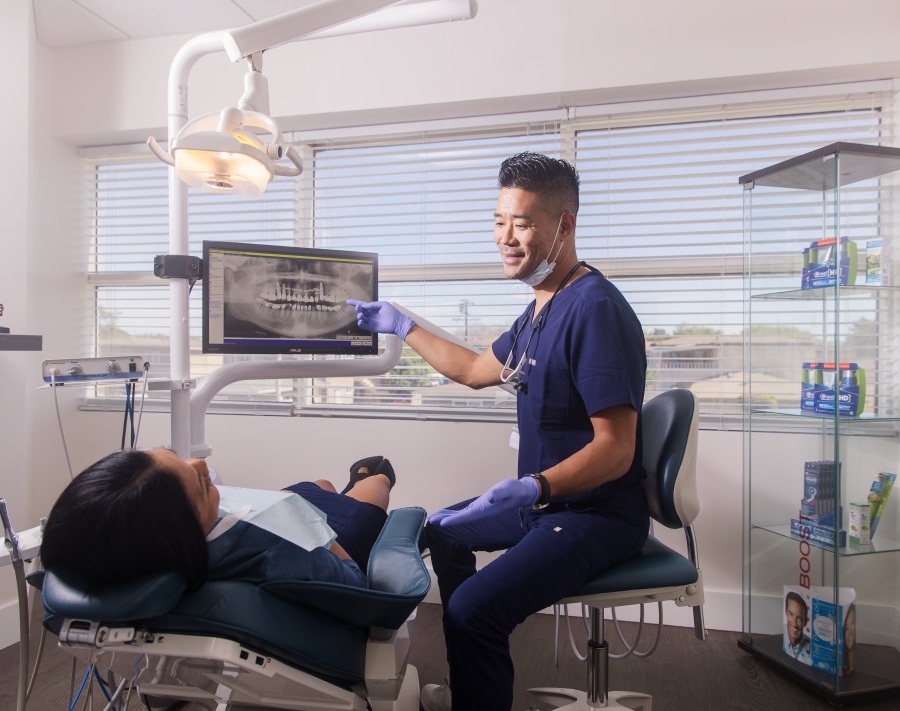
Initial consultation. Your dentist examines your mouth, takes X-rays, and discusses your goals. If teeth need to be extracted first, we’ll plan that into the timeline. We’ll also discuss which type of denture is the best fit for your situation and budget.
Impressions and measurements. Precise impressions of your gums and any remaining teeth are taken, along with measurements of how your jaws relate to each other. These are sent to a dental lab where your denture will be custom fabricated.
Try-in appointment. Before the final denture is completed, you’ll try on a wax model to evaluate the fit, bite, and appearance. This is your chance to see how the teeth look and request any changes to the shape, shade, or positioning before the final version is made.
Delivery and adjustment. When the finished denture arrives, we’ll place it, check the fit, and make any necessary adjustments. It’s normal for new dentures to feel a little different at first. Eating and speaking may take some practice during the first few weeks.
Follow-up visits. We’ll schedule follow-up appointments to check your comfort and make any additional adjustments as your mouth adapts. Sore spots are common in the early weeks and are easily resolved with minor modifications.

Frequently Asked Questions
Find answers to commonly asked questions about Dentures