

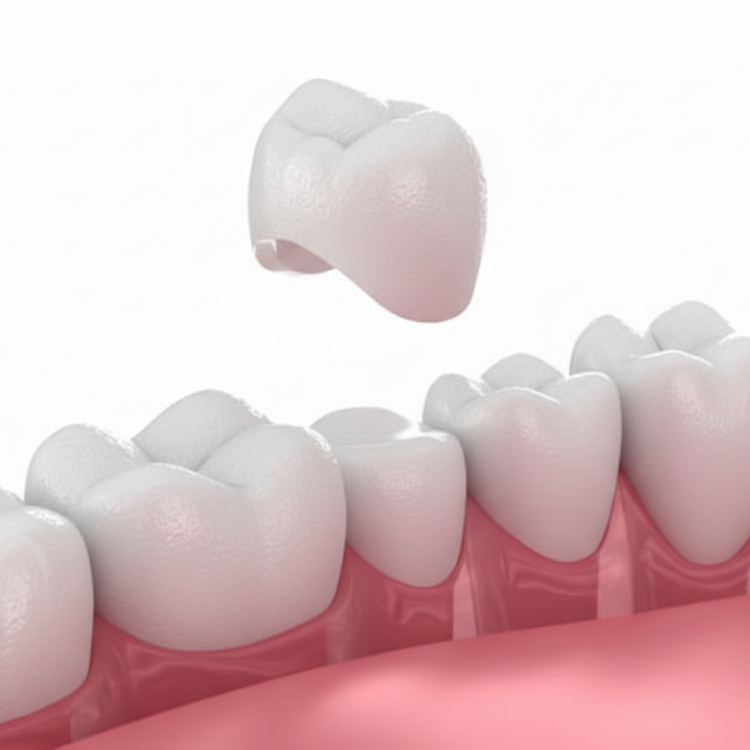
A dental crown is a custom-made cap that fits over a damaged, weakened, or discolored tooth. It restores the tooth’s shape, size, strength, and appearance while protecting it from further damage. Crowns are one of the most common and reliable restorations in dentistry, and with proper care, they can last 10 to 15 years or longer.
A dental bridge replaces one or more missing teeth by anchoring an artificial tooth (called a pontic) to the healthy teeth on either side of the gap. Bridges are permanently cemented in place, so they look and feel like your natural teeth. Unlike removable dentures, you don’t take them out to clean them, and they won’t shift or slip when you eat or speak.
At K&E Family Dental, our doctors design every crown and bridge to blend seamlessly with your existing teeth, matching the color, shape, and contour so the restoration is virtually undetectable.
When Is a Dental Crown Recommended?
Our doctors may recommend a crown when a tooth has been compromised and a simple filling isn’t enough to restore it. Common situations include:
After a root canal. Root canal therapy saves the tooth, but the treated tooth becomes more fragile. A crown protects it from cracking under the pressure of chewing. Because K&E has an endodontist (Dr. Craig Nakamatsu) on staff, your root canal and crown can be completed in the same office with seamless coordination between specialists.
Large cavities or fractures. When a tooth has significant decay or has cracked, there may not be enough healthy tooth structure left to hold a filling. A crown covers the entire visible portion of the tooth, restoring its full strength.
Worn or weakened teeth. Grinding, clenching, or years of wear can thin your teeth to the point where they need reinforcement. A crown brings back the tooth’s original shape and protects it from further damage.
Cosmetic concerns. Severely discolored, misshapen, or uneven teeth can be covered with a crown to create a more uniform, natural-looking smile.
To support a bridge. The teeth on either side of a missing tooth receive crowns that serve as anchors for the bridge.
Over a dental implant. After a dental implant post has fused with the jawbone, a crown is placed on top to complete the restoration.
When Is a Dental Bridge the Right Choice?
A bridge may be recommended when you’re missing one or more teeth and want a fixed, permanent solution. Leaving a gap in your smile isn’t just a cosmetic concern. Missing teeth can cause the surrounding teeth to shift out of alignment, change your bite, make chewing difficult, and even alter the shape of your face over time.
A bridge addresses all of these issues by filling the gap with a natural-looking replacement tooth that’s anchored securely to your existing teeth or dental implants.
Types of bridges we offer at K&E Family Dental:
Traditional bridge. The most common type. An artificial tooth is held in place by crowns on the teeth on both sides of the gap. This is ideal when you have healthy teeth on either side of the missing tooth.
Cantilever bridge. Similar to a traditional bridge, but anchored to only one adjacent tooth instead of two. This may be used when there’s only one healthy tooth available next to the gap.
Maryland bridge. Instead of using full crowns, a Maryland bridge uses a metal or porcelain framework bonded to the backs of adjacent teeth. This approach is more conservative because it requires less alteration of the surrounding teeth.
Implant-supported bridge. For patients missing multiple consecutive teeth, an implant-supported bridge attaches to dental implant posts rather than natural teeth. This is the most stable and long-lasting option. Our team can evaluate whether implants are right for your situation.

Why Lawndale Patients Choose K&E for Crowns and Bridges
Multiple specialists, one office. If your crown follows a root canal, our endodontist and your general dentist coordinate your care without you having to visit a separate office. If you’re considering an implant-supported bridge, our team can evaluate and plan the entire process in-house.
Experience that shows. Our doctors have placed thousands of crowns and bridges. Dr. Lin has been recognized as one of America’s Top Dentists in Cosmetic and General Dentistry by the Consumers’ Research Council of America, and our entire team trained at USC School of Dentistry.
Natural-looking results. We take the time to match the shade, shape, and translucency of your crown or bridge to your surrounding teeth. The goal is a restoration that nobody notices, not even you.
Most insurance accepted. Dental crowns and bridges are typically classified as major restorative procedures, and most insurance plans cover 50% or more of the cost. We accept most PPO insurance plans and offer CareCredit financing and payment plans for the remaining balance.
When Is a Dental Bridge the Right Choice?
A bridge may be recommended when you’re missing one or more teeth and want a fixed, permanent solution. Leaving a gap in your smile isn’t just a cosmetic concern. Missing teeth can cause the surrounding teeth to shift out of alignment, change your bite, make chewing difficult, and even alter the shape of your face over time.
A bridge addresses all of these issues by filling the gap with a natural-looking replacement tooth that’s anchored securely to your existing teeth or dental implants.
Types of bridges we offer at K&E Family Dental:
Traditional bridge. The most common type. An artificial tooth is held in place by crowns on the teeth on both sides of the gap. This is ideal when you have healthy teeth on either side of the missing tooth.
Cantilever bridge. Similar to a traditional bridge, but anchored to only one adjacent tooth instead of two. This may be used when there’s only one healthy tooth available next to the gap.
Maryland bridge. Instead of using full crowns, a Maryland bridge uses a metal or porcelain framework bonded to the backs of adjacent teeth. This approach is more conservative because it requires less alteration of the surrounding teeth.
Implant-supported bridge. For patients missing multiple consecutive teeth, an implant-supported bridge attaches to dental implant posts rather than natural teeth. This is the most stable and long-lasting option. Our team can evaluate whether implants are right for your situation.
Frequently Asked Questions
Find answers to commonly asked questions about Dental Crowns and Bridges.