

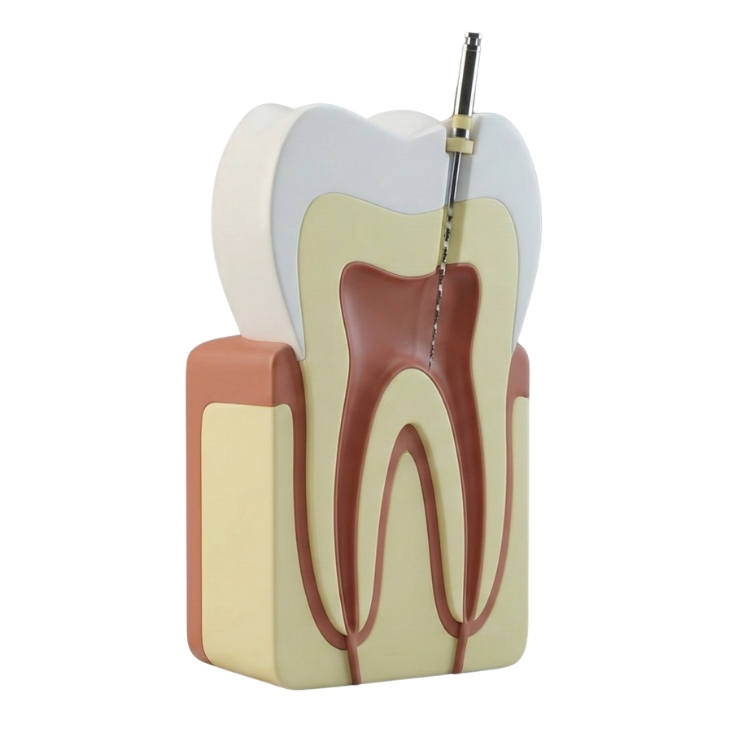
A root canal is a procedure that saves a tooth when the soft tissue inside it, called the pulp, becomes infected or inflamed. The pulp contains the tooth’s nerves and blood supply, and it sits in narrow channels (canals) that run through the roots of the tooth. When bacteria reach the pulp through deep decay, a crack, or repeated dental work on the same tooth, the tissue can become infected, causing pain, swelling, and sensitivity.
During a root canal, the infected pulp is carefully removed, the inside of the tooth is cleaned and disinfected, and the canals are sealed with a biocompatible filling material. A crown is then placed over the tooth to restore its strength and protect it from future damage.
The goal is simple: keep your natural tooth. A root canal allows you to save a tooth that would otherwise need to be extracted, preserving your bite, your smile, and the bone structure in your jaw.
How Do You Know If You Need a Root Canal?
Some infections develop slowly with subtle symptoms. Others announce themselves with sudden, intense pain. Either way, the sooner you’re evaluated, the better the outcome for your tooth.
Common signs include a severe, persistent toothache that may throb or radiate to your jaw, ear, or temple. Prolonged sensitivity to hot or cold that lingers well after the food or drink is gone is another warning sign, and it’s different from the brief sensitivity you might feel with a cavity. You may notice swelling or tenderness in the gums near the affected tooth, or a small bump on the gums that looks like a pimple (this is often a sign of an abscess). Darkening or discoloration of the tooth can indicate that the nerve inside has died. And in some cases, there’s no pain at all. The infection shows up on an X-ray during a routine exam before you ever feel a thing.
If you’re experiencing any of these symptoms, call us at (310) 371-6513. We’ll evaluate the tooth and let you know whether a root canal is needed.
What to Expect During Root Canal Treatment
Root canals have a reputation that’s worse than the reality. With modern techniques and anesthesia, most patients say the procedure feels similar to getting a filling. Here’s what happens.
Diagnosis and planning. Your dentist takes X-rays to see the shape of the root canals and determine the extent of the infection. This helps us plan the most effective approach for your specific tooth.
Numbing the area. Local anesthesia is administered to completely numb the tooth and surrounding tissue. If you’re anxious, sedation options are available. You should feel no pain during the procedure.
Accessing the pulp. A small opening is made in the top of the tooth to reach the pulp chamber and root canals inside.
Removing the infection. Using specialized instruments, the infected or inflamed pulp tissue is carefully removed from the canals. The inside of each canal is then cleaned, shaped, and disinfected to eliminate bacteria.
Sealing the tooth. The cleaned canals are filled with a rubber-like material called gutta-percha, and the opening in the tooth is sealed with a temporary or permanent filling.
Restoring the tooth. In most cases, a tooth that has had a root canal will need a crown to protect it from cracking. The treated tooth becomes more brittle without its living pulp, and a crown provides the structural reinforcement it needs to function normally for years to come.
The entire procedure typically takes one to two visits, depending on the complexity of the tooth. Molars with multiple curved canals may take longer than front teeth with a single, straight canal.

Root Canal or Extraction: Which Is Better?
When a tooth is badly infected, patients sometimes wonder if it would be easier to just pull it and move on. In some situations, extraction is the right call. But whenever a tooth can be saved, a root canal is almost always the better choice.
Your natural tooth is stronger and more functional than any replacement. It preserves the bone in your jaw, maintains proper spacing between your other teeth, and doesn’t require the additional procedures and cost that come with replacing an extracted tooth (whether through an implant, bridge, or denture).
A root canal followed by a crown can keep your natural tooth functioning for decades. In contrast, extraction starts a chain of follow-up decisions and expenses: do you get an implant, a bridge, or leave the gap? Each option has tradeoffs in cost, time, and long-term maintenance.
That said, not every tooth is a candidate for a root canal. If the tooth is too damaged, the root is fractured, or there isn’t enough healthy structure to support a crown, extraction may be the better path. Our team will give you an honest assessment and help you make the decision that’s right for your situation.

Frequently Asked Questions
Find answers to commonly asked questions about Root Canals